
If you’ve been searching for a wooden climbing frame online, you may have noticed just how much prices can vary. Two climbing frames can look very similar in photographs, yet one can cost considerably more than the other.
So why is that?
Is the more expensive climbing frame actually better, or are you simply paying more for the brand?
The answer isn’t always straightforward. Timber quality, treatment, dimensions, fixings, ropes, swing components, accessories, certification, guarantees, replacement parts and even the level of advice and support provided by the supplier can all make a difference.
After more than 22 years of supplying and installing outdoor play equipment, this is something we are often asked at Active Garden. In this guide, we’ll explain what to look at when comparing climbing frames, so you can make a more informed decision rather than simply choosing the lowest price.
Look at the Timber, Not Just the Overall Size
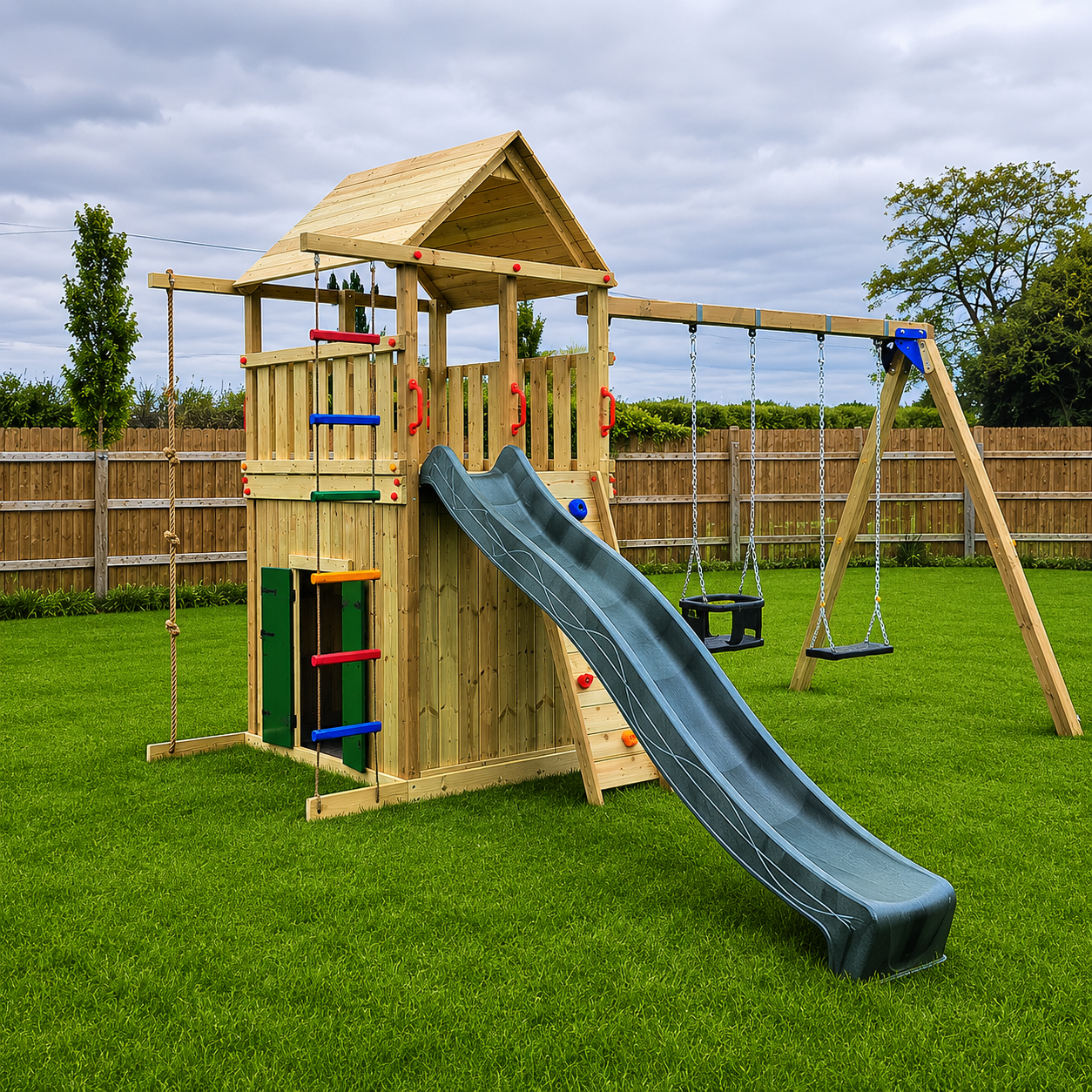
A large climbing frame isn’t necessarily made from substantial timber.
When comparing wooden climbing frames, look at the dimensions of the individual timber sections, particularly:
- Uprights
- Beams
- Swing beams
- Platform supports
- Floorboards
- Handrails and barriers
Thicker or larger-section timber can provide greater rigidity, although timber dimensions alone don’t determine the quality or strength of a climbing frame. The complete design, fixings and construction are equally important.
This is one reason two climbing frames that appear almost identical in an online photograph can feel quite different once assembled.
What type of timber is used?
It is also worth finding out what timber you are buying.
For example, the Blue Rabbit climbing frames supplied by Active Garden use pressure-treated Scandinavian Redwood, with FSC-sourced timber and a 10-year guarantee against rot and infestation, subject to the manufacturer’s terms and conditions.
Don’t be afraid to ask a supplier what type of timber is used. If you can’t easily find the information, ask.
Is the Timber Pressure Treated?
Outdoor play equipment spends its life exposed to rain, sunshine, frost and changing temperatures, so timber treatment is important.
Pressure treatment forces preservative deeper into the timber to help protect it against decay and insect attack.
This is different from simply applying a surface coating or stain.
When comparing prices, check:
- Is the timber pressure treated?
- What protection does the treatment provide?
- Is there a guarantee against rot or insect infestation?
- How long is the guarantee?
- Are there maintenance conditions attached to it?
A cheaper purchase price may look attractive, but the expected life of the equipment matters too.
A quality pressure-treated timber frame should not require constant re-treatment simply to keep the timber protected. Naturally, wooden play equipment still needs regular inspection and appropriate care, but the initial quality and treatment of the timber can make a significant difference to the amount of maintenance required over its life.
Check the Fixings and Connectors
This is one of the areas customers can easily overlook because fixings aren’t usually the most exciting part of a product photograph.
But after installing climbing frames for more than two decades, we can tell you that the smaller components matter too.
Look at the quality of:
- Bolts
- Screws
- Metal brackets
- Swing corners
- Swing hooks
- Ground anchors
- Handgrips
- Bolt covers
Good-quality fixings contribute to the stability, durability and usability of the finished climbing frame.
Some systems also use plastic caps over exposed bolt heads, which can provide a neater finish and help protect children from exposed hardware.
When comparing two products, look at the detailed photographs and specifications rather than only the main lifestyle image. The hardware can tell you quite a lot about the product.
What’s Actually Included in the Price?
This sounds obvious, but it can make a significant difference.
One climbing frame may initially appear cheaper because items shown in the photograph are optional extras.
Check whether the advertised price includes things such as:
- Slide
- Swing frame
- Swing seats
- Ground anchors
- Climbing wall
- Climbing stones
- Handgrips
- Roof or canopy
- Ladder
- Sandpit area
- Steering wheel, telescope or other play accessories
Also check whether the timber itself is included. Some modular play systems are sold in different ways, so make sure you understand exactly what will arrive.
Compare like with like rather than comparing the headline prices.
A climbing frame that looks cheaper at first may not remain cheaper once the accessories and components you actually want have been added.
Look at the Quality of the Swing Components
If the climbing frame includes a swing, don’t forget to compare the swing components too.
Look at:
- Swing seat construction
- Rope or chain type
- Swing hooks
- Is the rope or chain adjustable
- Maximum user weight
- Replacement seat availability
What type of rope is used?
Outdoor swing ropes can be made from different materials and constructions, including polyhemp (PH), polypropylene (PP) and braided ropes.
These materials and constructions have different characteristics, and the specification of the particular rope matters. When comparing climbing frames, don’t simply look at whether the photograph shows a rope swing.
Check what type of rope is actually supplied, how it is constructed and whether replacement ropes are available.
Polyhemp ropes, for example, are commonly used on quality outdoor play equipment and have a natural appearance. Polypropylene is another material used for outdoor ropes, while braided constructions can provide particular combinations of strength, flexibility and durability depending on the product.
Can the Climbing Frame Grow With Your Children?
This can be an important consideration when assessing value for money.
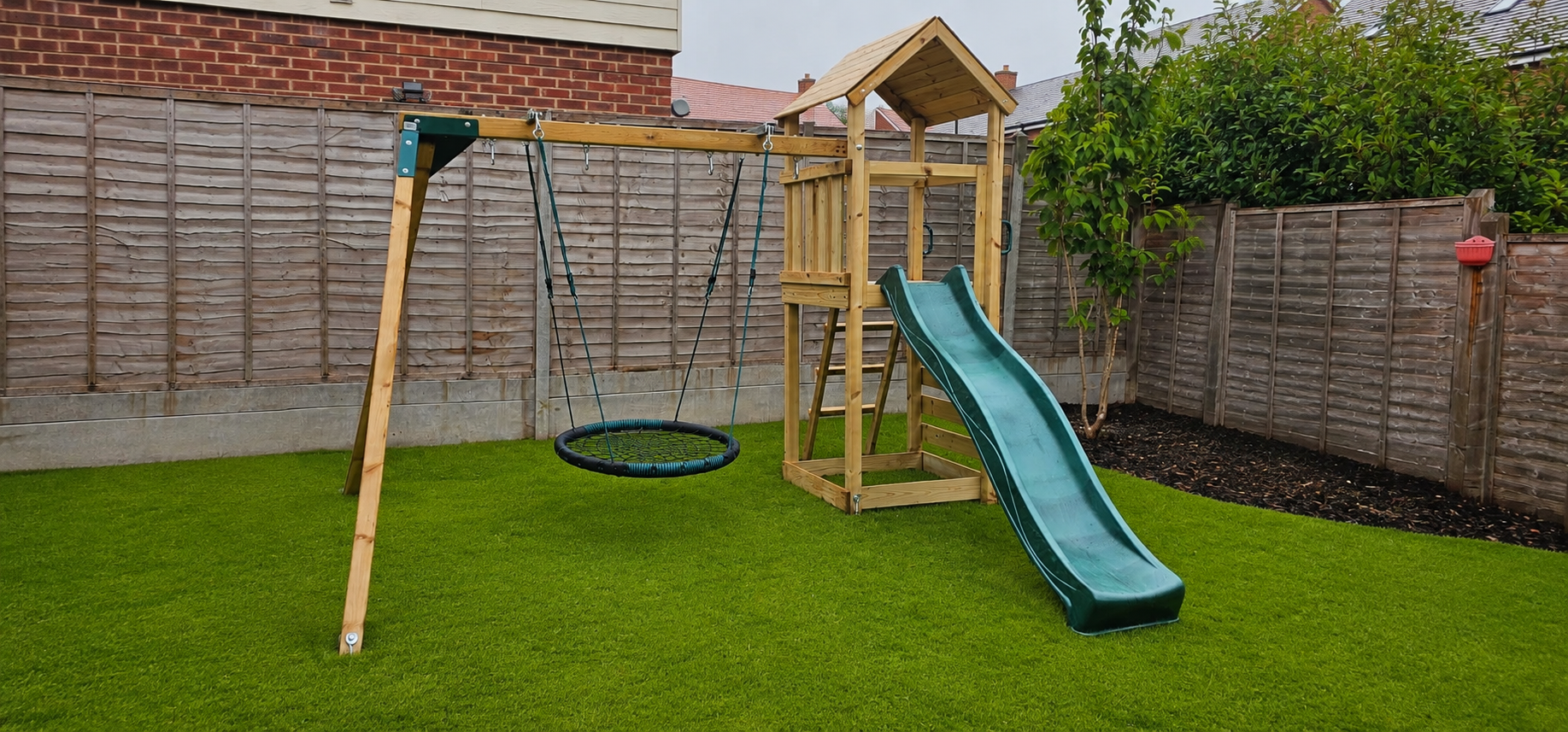
Some climbing frames are relatively fixed designs. Others are modular and can be changed or extended.
Depending on the system, you may be able to add:
- A swing module
- An additional tower
- A bridge
- Monkey bars
- A climbing wall
- Different swing seats
- A climbing net
- Additional play accessories
A modular climbing frame may cost more initially, but being able to adapt it as your children grow can extend the useful life of the equipment.
For example, a baby swing can potentially be replaced later with a flat swing seat, trapeze or another compatible accessory rather than replacing the entire swing frame.
If you are buying for a young child, it is worth asking yourself:
Will this climbing frame still interest them in three or four years?
Blue Rabbit is an excellent example of quality and modularity, climbing frames that allow flexibility in the design.
What About Ground Anchors?
Ground anchors aren’t particularly glamorous, but they are an important component.
Check whether suitable anchors are included with the climbing frame rather than discovering during assembly that you need to purchase them separately.
The anchoring method varies between manufacturers and models, so the equipment should always be installed in accordance with the manufacturer’s instructions.
We have covered ground anchoring and installation separately in our Knowledge Centre, so we won’t repeat all of that advice here. The important point when comparing prices is simply to establish whether the required anchoring components are included.
Has the Equipment Been Tested to an Appropriate Standard?
When buying children’s play equipment, check what testing or certification the manufacturer provides.
For residential children’s play equipment, you may see references to EN 71, the European standard covering the safety of toys.
Some manufacturers also use independent testing and certification organisations such as TÜV.
Commercial playground equipment is different from equipment designed for a private garden and is covered by different requirements, including EN 1176.
Be careful when comparing products marketed for different environments. A residential climbing frame and a commercial climbing frame may look similar online, but they are designed for very different levels and types of use.
Is the Timber Pre-Drilled?
This is an interesting one because pre-drilled doesn’t automatically mean better quality or ease of construction.
Some climbing frames arrive with many components pre-drilled, while other systems require holes to be drilled during assembly.
For example, Blue Rabbit timber is supplied cut to the required dimensions but is not pre-drilled. The necessary drill bits are supplied.
Drilling during assembly allows components to be positioned accurately as the structure is constructed.
The important consideration for a customer is therefore not simply “Is it pre-drilled?” but:
How straightforward is the system to assemble, and are clear instructions and the necessary components provided?
If you plan to build the climbing frame yourself, read the assembly information before buying so you understand what is involved.
Look Carefully at the Guarantee
A long guarantee sounds reassuring, but always check what the guarantee actually covers.
For a wooden climbing frame, there may be separate terms relating to:
- Rot
- Insect infestation
- Structural components
- Accessories
- Normal wear and tear
- Incorrect installation
- Commercial use of residential equipment
- Maintenance
- Manufacturer’s guarantee.
Timber is a natural material, so changes such as weathering, variations in colour, knots and natural movement are not necessarily manufacturing defects.
Our Knowledge Centre also contains advice about natural changes that can occur in outdoor timber, so it is worth reading that information if you would like to understand more about what to expect from wooden play equipment.
Consider the Size and Scale
Don’t judge the size of a climbing frame from photographs alone. Always check the actual dimensions.
Some brands have very compact towers whilst at the other end of the scale, many Blue Rabbit climbing frames have considerably larger towers and platforms.
The overall dimensions affect the amount of play space, the materials used and the footprint in your garden, and can therefore contribute to the price.
When comparing two climbing frames, check the platform size, platform height, overall height and height of the swing module if applicable and footprint, rather than assuming that similar-looking photographs mean similar-sized equipment.
A larger frame isn’t necessarily better — the right size depends on your garden, your children and how you intend to use it.
Think About the Investment Over Many Years
A good climbing frame is an investment in your children’s outdoor play.
Although a quality wooden climbing frame can represent a significant initial expense, it is worth considering how many years your family expects to use it, rather than looking only at the purchase price.
A climbing frame may be used by younger children initially and continue to be enjoyed as they grow, particularly if the design allows accessories or swing seats to be changed.
This is where the quality of the timber and its treatment becomes particularly important.
A good-quality, properly treated timber frame should be designed for long-term outdoor use and should not require constant re-treatment simply to keep it protected. Naturally, wooden equipment still needs regular inspection and appropriate care, but choosing a quality pressure-treated timber can reduce the need for ongoing preservative treatment.
When comparing two climbing frames, ask yourself:
“Which one am I more likely to still be happy with in five or ten years?”
The cheapest climbing frame isn’t necessarily the cheapest option over its useful life if it needs replacing sooner, has limited replacement parts available or requires considerably more maintenance.
For something your children may use for many years, longevity is an important part of value.
The Advice You Receive Before You Buy Matters
When buying a climbing frame online, it is easy to concentrate on the photographs, specifications and price.
But one of the most valuable things a good supplier can provide is help before you buy.
Every garden and every family is different. The biggest climbing frame isn’t necessarily the best one, and the cheapest one isn’t necessarily the best value.
A knowledgeable supplier should be able to help you consider:
- The age of the children.
- How many children will use the equipment.
- The space available in your garden.
- The height and size of the equipment.
- Which swing seats are appropriate.
- Whether you want to add accessories.
- How long you expect to use the equipment.
- Whether you intend to install it yourself.
- Whether professional installation would be advisable.
- What type of safety surfacing may be appropriate.
Sometimes a customer contacts us thinking they know exactly which climbing frame they want, but after discussing their garden and what they need from the equipment, a different model may actually be more suitable.
Good pre-sales advice isn’t about selling the most expensive product. It’s about helping the customer choose the right product.
That is an important distinction.
Look at the Supplier as Well as the Product
When you are spending a significant amount of money on a climbing frame, it is worth looking at the company you are buying from too.
A website can make a product look impressive, but ask yourself:
- How long has the company been trading?
- Do they have experience supplying play equipment?
- Do they install the equipment themselves?
- Can you speak to someone who understands the products?
- Do they have genuine customer reviews?
- Can you see photographs of their actual installations?
- Are they likely to still be there if you need replacement parts or advice several years from now?
- Do they provide useful information rather than simply trying to sell you something?
Look for genuine installation photographs
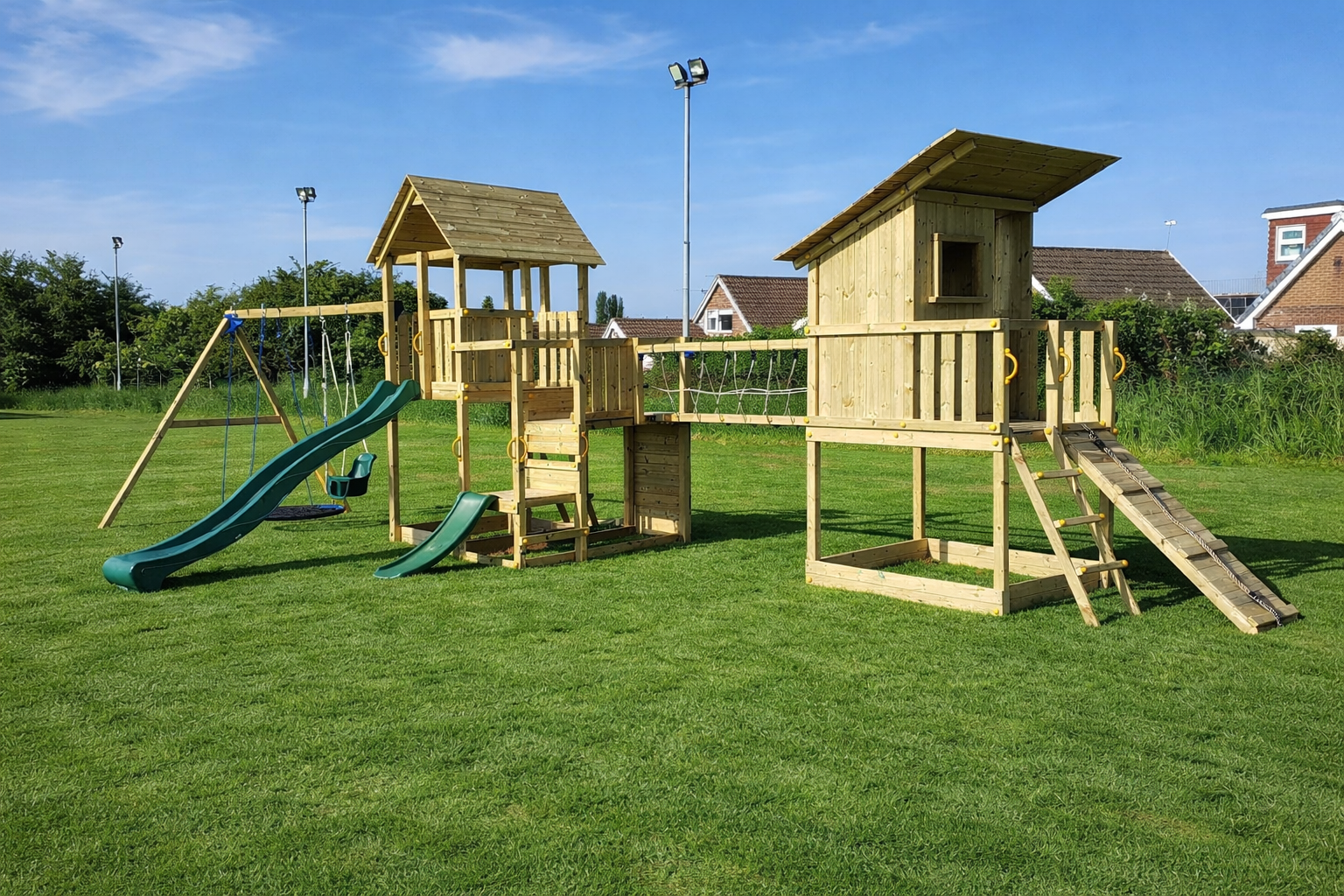
Stock photographs can show you what a product is supposed to look like, but photographs of actual installations can tell you much more.
Look at the supplier’s own installation photographs and customer projects. These can give you an idea of:
- What the equipment looks like once installed.
- The scale of the climbing frame in a real garden and people.
- How it looks on different types of ground.
- The quality of the finished installation.
- The types of gardens and spaces where the equipment has been installed.
At Active Garden, we have supplied and installed outdoor play equipment for over 22 years, and our website includes photographs and examples from actual customer installations.
Customer feedback matters too
Reviews can also tell you things that a product specification cannot.
Look beyond the star rating and, where possible, read what customers actually say about:
- The buying experience.
- Advice received before ordering.
- Delivery.
- Installation.
- Product quality.
- Communication.
- After-sales service.
A company that has been trading for many years and has a substantial history of genuine customer feedback gives you more information to work with than an unfamiliar website with little track record.
What Happens After You Buy?
The relationship with a supplier shouldn’t necessarily end when the climbing frame is delivered.
Outdoor play equipment is designed to be used for years, so it is useful to know what support is available afterwards.
For example:
- Can you contact the supplier if you have an assembly question?
- Can they help identify replacement parts?
- Are replacement swing seats and ropes available?
- Can you obtain additional accessories later?
- Is installation support available?
- Can they advise if you have a concern about the equipment?
- Do they value customer feedback after the purchase?
At Active Garden, we continue to deal with customers after their original purchase. In some cases, customers come back years later for additional equipment, replacement components or to develop their play area further.
That long-term relationship is part of the value of buying from an established specialist.
Does a More Expensive Climbing Frame Always Mean a Better Climbing Frame?
No.
Price alone is not a reliable measure of quality.
A more expensive climbing frame may include features you don’t need, while a simpler, less expensive model may be perfectly suitable for your family.
The aim shouldn’t be to buy the most expensive climbing frame you can afford.
Instead, look for good value:
A climbing frame that is well made, suitable for your children, appropriate for your garden and capable of providing years of use.
That is a much better comparison than price alone.
A Quick Checklist When Comparing Wooden Climbing Frames
Before making your decision, compare:
- Timber type and dimensions
- Pressure treatment
- Timber guarantee
- Quality of fixings and connectors
- Ground anchors
- Swing seats and ropes
- Type and construction of ropes
- What accessories are included
- Maximum user weights
- Safety certification
- Ability to add or change accessories
- Availability of replacement parts
- Assembly requirements
- Warranty terms
- Pre-sales advice
- Installation service
- After-sales support
- Customer reviews
- Actual installation photographs
- How long the supplier has been trading
If one climbing frame is substantially cheaper than another, this checklist can often help you understand where the difference lies.
Why Choose Active Garden?
Active Garden has been supplying outdoor play equipment since 2004.
Over more than 22 years, we have supplied and installed many different types of wooden climbing frames, swings and outdoor play equipment. That experience has given us a good understanding of which details make a difference once equipment leaves the catalogue photograph and is actually assembled, installed and used by children.
Our residential ranges include different styles, sizes and price points because we recognise that families have different gardens, budgets and requirements.
We don’t believe that the most expensive climbing frame is automatically the right choice for every customer. Our aim is to help you choose equipment that is appropriate for your children, your garden and the way you intend to use it.
If you are comparing climbing frames and aren’t sure what the differences in the specifications actually mean, ask us. We would rather help you choose the right equipment for your garden than simply recommend the most expensive option.
About the Author
Marianela @ Active Garden has more than 22 years of experience in the outdoor play equipment industry through Active Garden.
Her experience includes residential and commercial play equipment, climbing frames, swings, playground installations and safety surfacing, as well as helping customers choose equipment suitable for their particular space and requirements.
About Active Garden
Established in 2004, Active Garden Ltd supplies residential and commercial outdoor play equipment, including wooden climbing frames, swing sets, playground equipment, play components and safety surfacing.
© Active Garden Ltd 2026. All rights reserved. This article has been written exclusively for Active Garden Ltd. Please do not copy, reproduce or republish this content, in whole or in part, without our prior written permission.

