
Choosing a climbing frame or play equipment for your garden or playground is not just about measuring the equipment itself. You also need to think about the space around it, how children will move when using the equipment, the height of the play platforms, and the type of equipment and accessories included.
One of the most important things to consider when choosing a climbing frame is platform height, rather than simply the overall height of the structure. A climbing frame with higher platforms will generally require more consideration when it comes to safety areas, positioning and its relationship with surrounding features.
Slides, swings, bridges, monkey bars and other accessories can also increase the amount of space required.
At Active Garden, we have been supplying and installing outdoor play equipment for over 22 years, so we regularly help customers work out whether a particular climbing frame or playground will work in the space they have available.
Start with the manufacturer’s requirements
Before measuring your garden or playground, check the manufacturer’s installation and safety requirements for the particular equipment you are considering.
There is no single measurement that applies to every climbing frame. The required safety area can vary depending on the design, platform height, slide, swing, access points and other features.
For commercial playgrounds, the requirements are particularly important. Commercial play equipment needs to comply with the relevant playground safety standards, and the required safety areas and safety surfacing should be planned accordingly.
For residential play equipment, the measurements in this guide are intended as practical guidance. The requirements for a private garden are different from those for a public or commercial playground, but the manufacturer’s installation instructions should always be followed.

How much space does a climbing frame need?
As a general guide, we normally recommend allowing approximately 1.5–2 metres of safety space around the parts of the climbing frame that come into contact with the ground, such as posts, walls, ramps, nets and other accessible parts of the equipment.
However, this is a guide rather than a universal measurement. Always check the specific manufacturer’s requirements for the climbing frame you are buying.
The available space also needs to take account of what children will actually be doing on the equipment.
For example, a climbing frame with:
- a slide
- monkey bars
- a bridge
- a climbing wall
- a fireman’s pole
- a swing
- a rope or climbing net
may need more space than a simple tower.
This is why it is important to look at the complete climbing frame and its safety area, rather than simply measuring the footprint shown in the product dimensions.
Platform height matters
When comparing climbing frames, don’t just look at how tall the whole structure is.
A more important consideration for the play area is often the height of the platform. A frame with a higher platform can require a larger safety area and may also have greater implications when deciding where it can be positioned in a garden.
This is particularly worth considering if you are placing a climbing frame close to a fence, wall or neighbouring property.
How much space does a slide need?
Slides need additional space in front of them because children need somewhere to land and move away from the slide safely.
As a general guide, we recommend allowing approximately 2 metres in front of a slide, although this can vary depending on the height and design of the slide.
For commercial playgrounds, you should also allow approximately 1 metre either side of the slide, subject to the requirements for the specific equipment.
Always check the manufacturer’s safety-area requirements, particularly for commercial equipment.
If you have a smaller garden, one option is to choose a climbing frame with a fireman’s pole instead of a slide. This can sometimes reduce the footprint and the amount of safety area required compared with a slide.
How much space does a swing need?
Swings are slightly different from climbing frames because the main area of movement is in front of and behind the swing, rather than beside the swing legs.
For a typical residential swing, we normally recommend allowing approximately 3–3.5 metres in front of and behind the swing, measured from the top swing beam. The exact amount required depends on the swing design and chain length.
For commercial swings, approximately 4 metres in front and 4 metres behind the swing is a useful planning guide, giving around 8 metres of total clearance in the direction of movement. However, commercial playground requirements and the manufacturer’s specifications must always be checked.
What about space beside the swing?
Technically, the swing does not need the same type of safety clearance beside its legs because the movement of the swing is primarily forwards and backwards.
The legs can therefore sometimes be positioned relatively close to another feature.
However, we recommend leaving some space around the sides of a swing where possible. This gives children and supervising adults a more natural route around the equipment and makes it easier to move around the swing safely while it is being used.
Residential and commercial playgrounds are different
It is important not to treat residential and commercial playground requirements as being the same.
For residential equipment in a private garden, the measurements given in this article are practical guidance. The available garden space and the customer’s preferences will also play a part, but the manufacturer’s instructions should always be followed.
For commercial playgrounds, there are specific safety standards and requirements that need to be considered when planning the equipment, safety areas and surfacing.
Commercial equipment should therefore be planned and installed in accordance with the relevant requirements rather than simply using the residential measurements as a guide.
At Active Garden, we supply and install both residential and commercial play equipment and can help customers consider the space required for their particular project.
Think about the whole safety area
One of the easiest mistakes to make is to measure the climbing frame itself and assume that this is the amount of garden required.
For example, a climbing frame might have a footprint of a certain size, but the actual area required could be considerably larger once you have allowed for the safety areas around the equipment.
The safety area should be kept clear of hard objects and other potential hazards such as:
- walls
- sheds
- fences
- posts
- garden structures
- other play equipment
- hard landscaping
Again, the exact requirements depend on the equipment and whether it is residential or commercial.
It is also important to consider what is happening outside the immediate safety area. A garden may technically have enough room for a climbing frame, but the best position isn’t always the one that uses every available centimetre.
Consider trees and other garden features
A tree does not automatically mean that a climbing frame cannot be installed nearby.
Every situation is different, so trees and other garden features should be considered based on their position, branches, roots and relationship to the equipment.
The important thing is to make sure that the equipment can be positioned safely and that the manufacturer’s requirements are met.
Sometimes moving a climbing frame by even a small amount can make a significant difference to how well the garden works as a whole.
Don’t forget planning and your neighbours
Before deciding exactly where to position a climbing frame or other play equipment, it is worth considering more than just the available space.
Planning requirements can vary depending on where you live, so customers should check any local requirements that may apply before installing equipment, particularly if it is close to a boundary.
This can be especially important with climbing frames because of the height of the platforms.
It is also worth thinking about your neighbours. A climbing frame positioned close to a fence or boundary can have a greater visual impact than equipment at ground level.
If children can see over a fence from a climbing frame, or the equipment will be clearly visible from a neighbour’s windows, it is sensible to consider whether its position could be intrusive or cause concern.
We normally advise customers to think about whether their neighbours would be comfortable with the proposed position and, where appropriate, have a conversation with them before installation.
This isn’t necessarily about saying you cannot put a climbing frame in a particular position. Planning requirements and individual circumstances vary, but considering these issues before installation can help avoid problems later.
Don’t forget about access to the equipment
You also need to think about how children and adults will move around the play equipment.
A climbing frame may fit into a particular area on paper, but if it leaves only a narrow gap between the equipment and a fence or another garden feature, it may not be the most practical location.
Think about:
- How children will get to and from the equipment
- Where adults will stand when supervising
- Whether there is enough room to move around the equipment
- How the equipment will be accessed for maintenance
- Whether you need access to mow or maintain the surrounding grass
- Whether gates, paths or other garden features affect the available space
This is particularly important with swings, where leaving some room around the sides can make the whole area easier to use even though the main safety clearance is front and back.
How much space do I need for safety surfacing?
The type of surface you choose can also affect how you plan your play area.
For residential equipment, a good, well-maintained lawn can be perfectly suitable for many climbing frames, depending on the equipment, platform height and manufacturer’s requirements.
However, grass can become worn in areas where children regularly land or run, and its cushioning performance can be affected when the ground becomes very hard during periods of hot, dry or cold weather.
For this reason, some customers choose to install additional safety surfacing.
Options include:
- Rubber grass mats
- Woodchip and bark
- Rubber chippings
- Wetpour rubber
- Bonded rubber bark
- Artificial grass
- Visit our section about safety surfacing for more details.
What if my garden is too small for a climbing frame?
Don’t automatically assume that you cannot have play equipment simply because you have a smaller garden.
The key is to choose equipment that is appropriate for the space.
For example, a smaller climbing frame may have:
- A lower platform
- A smaller slide
- A fireman’s pole instead of a slide
- Fewer accessories
- A more compact swing arrangement
It can sometimes be better to choose a slightly smaller frame that leaves a good amount of usable garden around it rather than trying to fit the largest possible climbing frame into the available space.
Remember that the equipment footprint is not the same as the total space required. Always allow for the appropriate safety areas and consider how the equipment will actually be used.
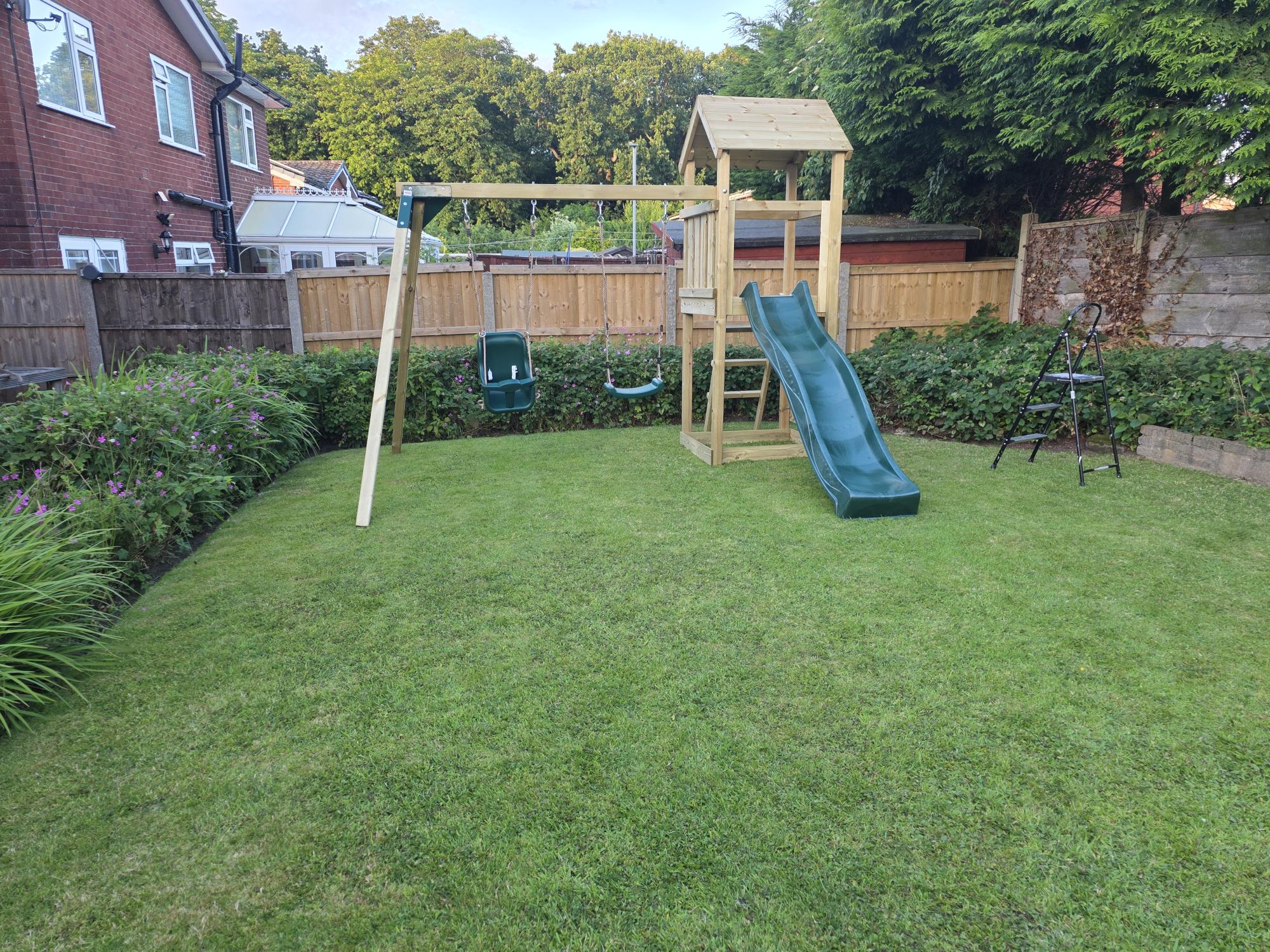
A simple way to work out how much space you need
Before buying a climbing frame or playground, we recommend working through these questions:
1. What is the platform height?
This can be more important than the overall height of the frame when considering the play area and its position.
2. What accessories does it have?
Check slides, swings, monkey bars, bridges, climbing walls, fireman’s poles and other features.
3. What is the manufacturer’s required safety area?
Always use the manufacturer’s requirements for the specific equipment.
4. Is it residential or commercial?
Commercial playgrounds have specific standards and requirements that must be followed.
5. What surface will you use?
Consider whether grass is suitable or whether you need rubber grass mats, wetpour, bonded rubber bark or another safety surface.
6. Are there fences, walls, sheds or other hard objects nearby?
Make sure they do not interfere with the required safety area.
7. What are the planning considerations?
Particularly when equipment is close to a boundary or has high platforms.
8. What will your neighbours see?
Think about whether children will be able to see over a fence or whether the equipment could be intrusive from a neighbour’s property.
9. Can people move comfortably around the equipment?
Don’t just measure whether it fits. Think about how children, parents and supervisors will actually use the space.
Frequently Asked Questions
How much space should I leave around a climbing frame?
As a general guide, approximately 1.5–2 metres around the parts of the equipment that come into contact with the ground is often used for residential climbing frames, but the manufacturer’s specific safety requirements should always be followed. Commercial playgrounds have additional requirements that must be followed.
How much space does a swing need?
For a typical residential swing, we normally recommend approximately 3–3.5 metres in front of and behind the swing, depending on the design and chain length.
For commercial swings, approximately 4 metres in front and behind is a useful planning guide, giving around 8 metres of clearance in the direction of swing movement. Always check the specific commercial requirements.
Does a swing need space beside the legs?
The main safety clearance for a swing is normally in front of and behind the swing rather than beside the legs.
However, we recommend leaving some space around the sides where possible to provide a better flow of movement around the equipment.
Can I put a climbing frame next to a fence?
It may be possible, but you should check the manufacturer’s requirements and consider any local planning requirements that may apply. The height of the climbing frame and its platforms can also make its position more noticeable to neighbouring properties.
Can I have a climbing frame in a small garden?
Yes. There are many compact climbing frames designed for smaller gardens. Look at the platform height, equipment footprint, accessories and required safety area rather than simply choosing a frame based on its overall dimensions.
Is grass suitable underneath a climbing frame?
Good, well-maintained grass can be suitable for many residential play areas, depending on the equipment and manufacturer’s requirements. However, grass can become worn or hard, so some customers choose additional safety surfacing such as rubber grass mats.
Do I need safety surfacing around a residential climbing frame?
Not necessarily. It depends on the equipment, its platform height, the manufacturer’s requirements and the condition of the ground. For commercial playgrounds, safety surfacing and impact attenuation requirements are much more specific and must be addressed as part of the playground design.
Need help choosing the right equipment?
If you’re unsure whether a particular climbing frame, swing or playground will fit into your available space, it’s always worth checking before you buy.
At Active Garden, we can help you consider the equipment dimensions, platform height, safety area and practical layout so that you can choose equipment that works properly within your garden or playground.
Explore our residential climbing frames or find out more about our commercial playground equipment and installation services.
About the Author
Marianela @ Active Garden
Marianela is part of the Active Garden team and has over 22 years of experience supplying and installing outdoor play equipment for homes, schools, nurseries, pubs, holiday parks and other commercial settings.
This practical experience helps Active Garden provide advice based not only on product specifications, but also on how play equipment works in real gardens and playgrounds.
About Active Garden
Established in 2004, Active Garden Ltd supplies and installs residential and commercial outdoor play equipment and safety surfacing throughout the UK.
With over 22 years of experience, we help customers choose play equipment that is appropriate for their available space, intended use and budget.
© Active Garden Ltd 2026. All rights reserved.
This article has been written exclusively for Active Garden Ltd. Please do not copy, reproduce or republish this content, in whole or in part, without our prior written permission.

