

Do I need safety surfacing under my climbing frame?
This is one of the questions we are asked regularly, and the answer isn’t always as straightforward as simply choosing the softest or most expensive surface.
The right safety surface depends on several things:
- Whether the equipment is residential or commercial.
- The height from which a child could fall.
- The size and layout of the play equipment.
- How much space is available around it.
- What surface you already have.
- How the area will be used.
- How much maintenance you are prepared to do.
- Your budget and the appearance you want to achieve.
At Active Garden, we supply residential and commercial play equipment as well as a range of safety surfacing. After more than 22 years in the industry, we’ve seen that the best solution isn’t necessarily the most expensive one.
For some residential climbing frames, a good lawn may be perfectly suitable. For a busy commercial playground, a professionally installed impact-attenuating surface may be essential.
The equipment, the space and the surface all need to be considered together.
Residential and Commercial Play Equipment Are Different
The first thing to establish is whether the climbing frame or play equipment is intended for private residential use or commercial/public use.
Residential climbing frames
For many residential climbing frames in a private garden, you may not need a specialist rubber safety surface.
A good, well-maintained grass surface can be suitable for many residential climbing frames where the fall height is appropriate and the ground underneath is suitable.
This is worth considering before removing an existing lawn and installing an expensive specialist surface.
We sometimes speak to customers who have been advised that they need to replace their grass with woodchip, wetpour or another surface when their existing lawn may already be perfectly adequate for their equipment.
Safety is important, but more expensive doesn’t automatically mean better or safer for every garden.
Commercial playground equipment
Commercial play equipment is different.
It is designed for more intensive use and is subject to different requirements from residential play equipment. The equipment, fall heights, layout, surfacing and maintenance all need to be considered together.
For commercial playgrounds, the surfacing needs to be appropriate for the equipment’s required Critical Fall Height (CFH) and the relevant playground safety requirements.
BS EN 1177 provides methods for assessing the impact-attenuating properties of playground surfacing and determining its Critical Fall Height.
This is why commercial playground surfacing should be planned as part of the playground design rather than added as an afterthought.
What Is Critical Fall Height?
Critical Fall Height (CFH) is an important consideration when choosing playground surfacing.
In simple terms, it relates to the height from which the tested surface provides the required level of impact attenuation.
It isn’t necessarily the overall height of the climbing frame.
A climbing frame may have a roof or other feature that is considerably higher than the highest point from which a child could reasonably fall. The relevant fall height is therefore based on the potential fall from the equipment rather than simply measuring the highest point of the structure.
The specific equipment and its manufacturer’s information should always be checked when determining the required surfacing.
Can Grass Be Used Under a Residential Climbing Frame?
Yes, in many cases.
A good, well-maintained grass surface can be a perfectly sensible choice for suitable residential play equipment.
Guidance commonly recognises well-maintained grass as capable of providing impact attenuation for fall heights of up to around 1.5 metres, provided the grass is in good condition and the underlying ground is suitable.
This is one reason we don’t automatically recommend that residential customers remove a perfectly good lawn and replace it with a specialist surface.
But grass changes with the weather
Grass and the ground underneath it don’t perform exactly the same way throughout the year.
Hot, dry weather can make the ground hard.
Very cold weather can also affect the ground conditions.
Heavy use can wear away the grass, particularly:
- Under swings.
- Around climbing areas.
- Around slide exits.
- In areas where children repeatedly land or run.
When the ground becomes very hard or the grass becomes worn, its ability to cushion a fall can be reduced.
This is when we may recommend adding rubber grass mats to specific high-use areas.
You Don’t Necessarily Need to Replace Your Lawn
This is something we feel strongly about.
If you have a good lawn, suitable ground conditions and residential equipment with an appropriate fall height, keeping the grass may be the simplest and most cost-effective solution.
You may not need:
- Excavation.
- A specialist sub-base.
- Edging.
- Loose-fill material.
- A rubber surface.
- Ongoing topping-up of woodchip.
Instead, you may simply need to maintain the grass properly and consider safety mats in areas that experience heavy wear.
Of course, some customers choose a different surface for another very good reason: they want a cleaner, drier play area that can be used throughout the year.
Why Choose a Different Surface From Grass?
Grass can become:
- Muddy after prolonged rain.
- Wet for long periods.
- Worn around busy equipment.
- Hard during hot, dry weather.
- Difficult to maintain in areas of heavy use.
Some families therefore prefer a more permanent surface because they want their children to be able to use the climbing frame without creating muddy patches or bringing mud into the house.
Wetpour and bonded rubber bark are popular choices where customers want a more defined, durable play area.
However, they can be considerably more expensive than keeping an existing lawn.
This is often when customers initially like the idea of a specialist surface but, once they see the cost of preparing and installing it, decide that their existing lawn is perfectly acceptable after all!
And that’s absolutely fine.
Our aim is to help customers understand the options rather than automatically recommending the most expensive solution.
What About Woodchip or Bark?
Woodchip and bark are traditional playground surfaces and can provide a natural-looking play area.
They can be used as loose-fill impact-attenuating surfaces, but there are several disadvantages that are worth considering, particularly for residential gardens.
Woodchip and bark can:
- Blow or move around.
- Become displaced by children playing.
- Become wet and remain wet for long periods.
- Compact over time.
- Break down and rot.
- Need topping up.
- Require regular raking.
- Become mixed with soil and debris.
- Wear away in busy areas.
- Attract animals, including pets and wildlife, which can result in the surface becoming soiled.
For commercial playgrounds, loose-fill surfaces require particularly careful maintenance because children can displace the material from the areas where it is needed most.
The depth on the day of installation isn’t necessarily the depth that remains after months of use.
This means regular inspection and maintenance are important.
If a customer already has a good lawn for suitable residential equipment, we would generally not recommend removing it simply to replace it with woodchip unless there is a particular reason for doing so.
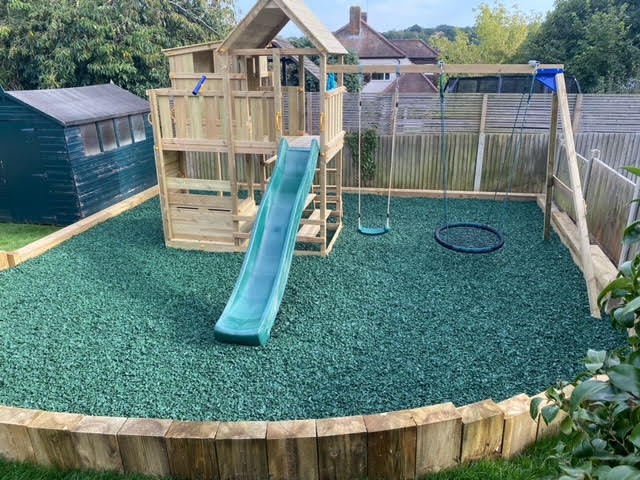
What About Rubber Chippings?
Rubber chippings can provide an alternative to natural woodchip, particularly for customers who like the appearance and feel of a loose-fill surface but want to avoid some of the disadvantages associated with natural materials.
Rubber chippings have several advantages:
- They are heavier than natural woodchip and are less likely to blow around.
- They don’t rot in the same way as natural woodchip.
- They are less prone to compaction.
- They generally require less depth than some natural loose-fill materials.
- They are available in different colours, including natural-looking options.
- They provide a longer-lasting loose-fill surface.
They can therefore be a good compromise between a natural-looking loose surface and a more permanent playground solution.
Are there disadvantages?
Yes.
Rubber chippings can become hot in direct sunlight, particularly darker colours during very warm weather.
They are also still a loose-fill material, so they can move with use and need to be checked and maintained.
No safety surface is completely maintenance-free.
What Are Rubber Grass Mats?
Rubber grass mats are one of our favourite safety-surfacing options, particularly for commercial playgrounds.
They provide a different solution from loose-fill materials such as woodchip and rubber chippings.
The mats are installed at a specified thickness to provide the required level of impact attenuation, so the protective material isn’t dependent on loose material remaining evenly distributed after children have been playing.
They are also very low maintenance compared with loose-fill surfaces.
Grass can grow through the openings in the mats, allowing the play area to retain a natural appearance while providing cushioning underneath.
And yes — you can mow the grass over the mats once the grass has established.
Advantages of rubber grass mats include:
- Consistent cushioning.
- Very low maintenance compared with loose-fill surfaces.
- Grass can grow through the openings.
- A natural-looking finished appearance.
- No topping-up of displaced woodchip.
- No rotting of the safety material.
- Particularly useful in high-use areas.
- Suitable for many commercial playground applications when the correct product and installation system are selected.
For commercial playgrounds, this consistency can be a major advantage.
With loose-fill surfacing, regular maintenance is needed because material can be displaced from the areas where children are most likely to fall.
With appropriately installed rubber grass mats, the impact-attenuating material stays in place.
They can also be used strategically rather than necessarily covering every part of a large site, depending on the design and required safety areas.

What About Wetpour?
Wetpour is a continuous rubber safety surface made from rubber granules bound together on site.
It is particularly popular for:
- Schools.
- Nurseries.
- Commercial playgrounds.
- Public play areas.
- Other high-use environments.
It can provide a smooth, defined surface and is available in different colours and designs.
However, wetpour requires proper preparation underneath.
If you’re starting with grass or soil, the area may require excavation, a suitable sub-base, drainage considerations and edging before the wetpour itself can be installed correctly.
This preparation can make a wetpour installation considerably more expensive than customers initially expect.
The thickness and construction of the wetpour system also need to be appropriate for the required fall height.
So when comparing wetpour prices, don’t just compare the cost of the rubber surface itself. Ground preparation can be a significant part of the project.
Find out more about our wetpour safety surfacing and the options available for commercial and residential projects

What About Bonded Rubber Bark?
Bonded rubber bark provides the appearance of a natural bark surface while using rubber material bonded together to create a more permanent safety surface.
It can be a particularly attractive option for customers who like the natural appearance of bark but don’t want the loose material, displacement, rotting and topping-up associated with traditional woodchip.
One of the advantages of bonded rubber bark
Unlike some other continuous surfaces, bonded rubber bark can be installed without an edge in appropriate situations.
It can also be shaped around the required safety area, making it particularly useful where the play area has an irregular shape or needs to follow the contours of the equipment.
This can make it easier to create a natural-looking safety area around climbing frames and playground equipment without having to create a rigid rectangular surface.
As with wetpour, the ground underneath needs to be appropriately prepared and the specification needs to be suitable for the equipment and required fall height.
Bonded rubber bark can be particularly suitable for:
- Commercial playgrounds.
- Schools.
- Nurseries.
- Pubs.
- Holiday parks.
- Residential customers wanting a more permanent natural-looking surface.

What About Rubber Tiles?
Rubber safety tiles are another option for suitable play areas.
They provide a defined rubber surface and can be available with different impact-attenuation performance depending on the product and thickness.
However, the base underneath is very important.
Rubber tiles need a flat, stable and level surface.
We don’t generally recommend installing them directly over grass or soil unless the area has first been properly prepared to provide a suitable, stable and level base.
If the ground is uneven, simply putting rubber tiles on top will not solve the underlying problem.

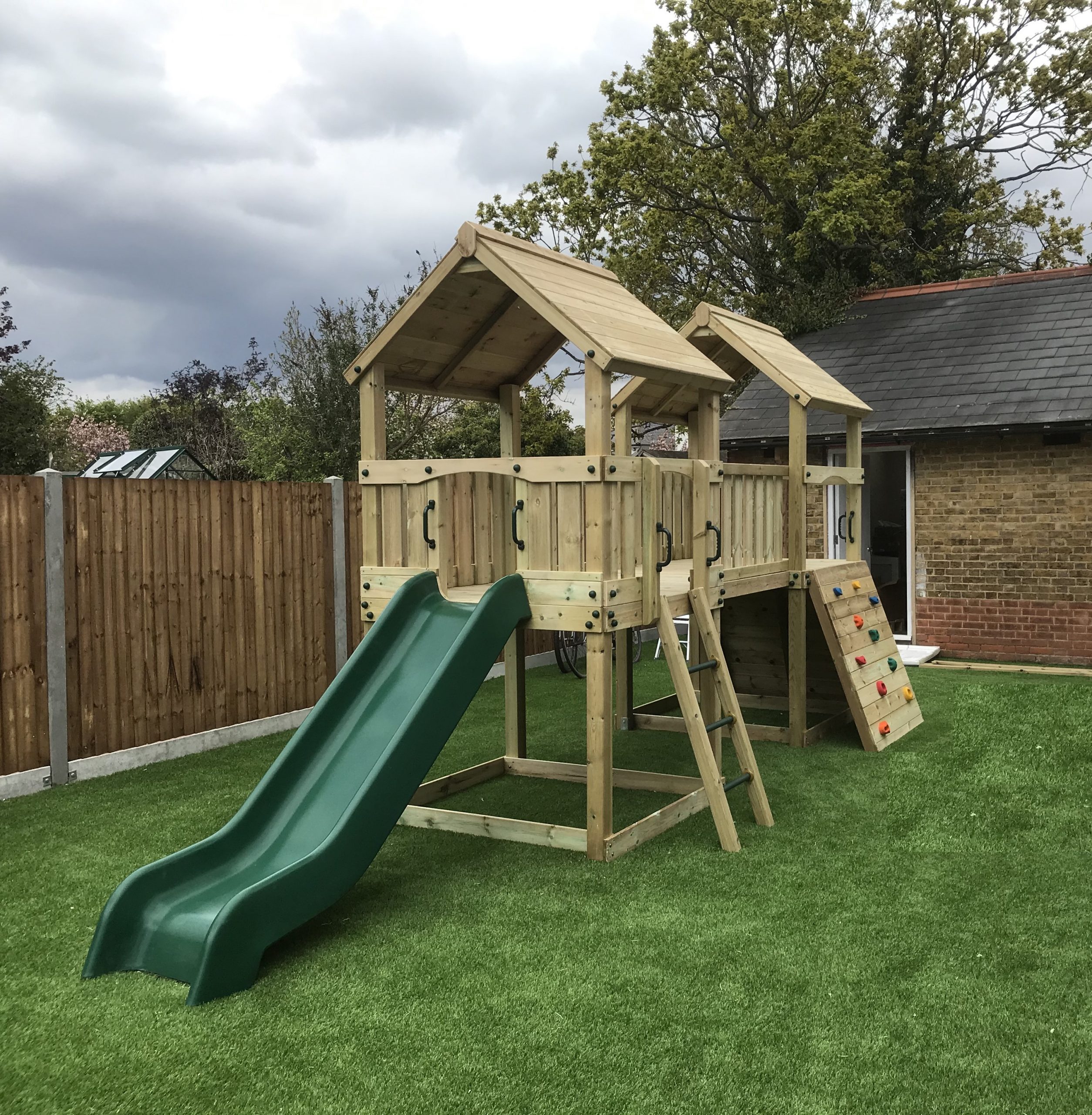
What About Artificial Grass?
Artificial grass can look very attractive around a climbing frame and is popular with customers who want a neat, low-maintenance-looking garden.
However, an important point is sometimes overlooked:
Artificial grass itself is not necessarily a safety surface.
Where impact attenuation is required, an appropriate cushioning layer or shock pad needs to be incorporated underneath the artificial grass.
The artificial grass provides the finished appearance, while the underlying system provides the impact attenuation.
So if you’re considering artificial grass around play equipment, don’t simply ask:
“Is the artificial grass soft?”
Ask:
“What impact-attenuating system is underneath it, and what fall height is that system suitable for?”
How Much Safety Surfacing Do I Need Around a Climbing Frame?
Another common misconception is that you only need to put safety surfacing directly underneath the climbing frame.
That’s not enough.
The surface needs to extend beyond the equipment into the areas where a child could potentially fall or land.
As a general planning guide, we often allow approximately 1.5–2 metres beyond the parts of the equipment that reach the ground, such as legs, ramps, climbing walls or nets.
However, this is guidance rather than a universal measurement.
The exact safety area must always be checked against the manufacturer’s instructions and the specific equipment.
Slides
As a general guide, we allow approximately 2 metres in front of a slide, unless it is a particularly low slide.
We also allow appropriate space to either side of the slide, with approximately 1 metre either side being a useful planning guide.
Again, the exact requirements depend on the slide and should be checked against the manufacturer’s specifications.
Swings
The required safety area for a swing depends particularly on the length of the swing chains or ropes and the design of the swing. For a residential climbing frame this means 3-3.5m front and back of where the swings hang from, is needed.
This means there isn’t one measurement that can safely be applied to every swing.
Always check the manufacturer’s specified use and safety area for the particular swing you are installing.
The important point
Don’t order your safety surfacing until you’ve established the required area for the actual equipment.
The equipment footprint, fall areas, slide exit area and swing clearance all need to be considered when calculating how much surfacing you need.
This is especially important for commercial playgrounds.
Think About the Space Before Choosing the Surface
We recommend working backwards.
Step 1 – Choose the equipment
What climbing frame, slide, swing or play system are you installing?
Step 2 – Establish the equipment footprint
How much room does the actual equipment take up?
Step 3 – Allow for the required safety areas
How much additional space is needed around it?
Step 4 – Look at your existing ground
Are you starting with:
- Grass?
- Soil?
- Tarmac?
- Concrete?
- An existing playground surface?
- Another hard or soft surface?
Step 5 – Consider the fall height
What is the relevant fall height of the equipment?
Step 6 – Choose the appropriate surface
Only then should you decide whether you need:
- Grass.
- Rubber grass mats.
- Rubber chippings.
- Woodchip or bark.
- Wetpour.
- Bonded rubber bark.
- Rubber tiles.
- Artificial grass with appropriate cushioning.
- Or another suitable surface.
This approach can save customers a considerable amount of money.
Your Existing Ground Makes a Big Difference
The surface you are starting with can have a major effect on the cost and practicality of installing safety surfacing.
Starting with grass or soil
You may need considerable preparation for some surfaces.
Wetpour and bonded rubber bark, for example, require appropriate preparation underneath.
Starting with tarmac
Some safety-surfacing systems may be able to use an existing hard surface as part of the preparation, depending on its condition and the particular system.
Starting with concrete
Again, the condition, level and suitability of the existing base need to be assessed before deciding which surface is appropriate.
Starting with an uneven surface
This is particularly important for rubber tiles.
A surface that isn’t flat and level will need to be properly prepared before tiles can be considered.
The same safety surface can therefore have very different installation costs depending on what you are starting with.
Which Safety Surface Is Best?
There isn’t one surface that is best for every project.
For many residential gardens
Good, well-maintained grass may be perfectly adequate for suitable equipment and fall heights.
Rubber grass mats can then be added to areas where the ground becomes worn or hard.
For a natural-looking residential play area
Grass or rubber grass mats may be preferable to loose woodchip.
For a loose-fill alternative
Rubber chippings can provide some of the benefits of loose-fill surfacing while avoiding some of the disadvantages of natural woodchip.
For commercial playgrounds
Wetpour, bonded rubber bark, rubber grass mats, rubber chippings, rubber tiles or another appropriately tested system may be suitable depending on the equipment, fall heights, site and budget.
For an all-year-round play area
Wetpour or bonded rubber bark can provide a more permanent surface and avoid the mud and wet grass that some customers want to avoid.
For a natural grass appearance on a commercial playground
Rubber grass mats are one of our preferred options.
They provide consistent cushioning while allowing grass to grow through, and they require considerably less maintenance than loose-fill surfaces.
For a neat artificial lawn appearance
Artificial grass can be used, but where impact attenuation is required it needs an appropriate cushioning system underneath.
Don’t Forget About Maintenance
Whatever surface you choose, maintenance is important.
A safety surface isn’t something that can simply be installed and forgotten.
Regular checks should look for:
- Worn areas.
- Displacement.
- Holes or damage.
- Exposed fixings or foundations.
- Compacted loose-fill.
- Damaged edging.
- Drainage problems.
- Vegetation where relevant.
- Areas where the surface no longer provides the intended coverage.
This is particularly important with loose-fill materials because the surface can be displaced through everyday use.
A safety surface is only useful if it continues to perform as intended.
Our Advice: Don’t Overspecify Your Residential Garden
This is something we feel strongly about.
Safety is important, but more expensive doesn’t automatically mean safer or better for your particular garden.
If you have a suitable residential climbing frame and a good lawn, you may not need to spend thousands of pounds replacing your grass with wetpour.
Likewise, we wouldn’t recommend installing woodchip simply because it looks like a traditional playground surface if it introduces additional maintenance and doesn’t solve a problem you actually have.
Sometimes the best solution is simply:
Keep the grass. Maintain it well. Add grass mats where they are needed.
For another customer, the correct answer might be wetpour, bonded rubber bark, rubber chippings, rubber tiles or artificial grass with an appropriate cushioning system.
The right solution depends on the:
- Equipment.
- Fall height.
- Available space.
- Existing ground.
- Intended use.
- Maintenance requirements.
- Appearance.
- Budget.
What We’ve Learned After More Than 22 Years
After more than 22 years supplying and installing climbing frames and playground equipment, we’ve learned that safety surfacing needs to be considered as part of the whole project, rather than as something added underneath the equipment at the end.
We’ve also learned that customers don’t always need the most expensive solution.
For residential customers especially, a good lawn can often be an excellent starting point.
For commercial playgrounds, the requirements are more demanding and the equipment, fall zones and impact-attenuating surfacing need to be carefully considered together.
We’ve also seen customers choose a surface because they like the way it looks or because they want an all-year-round play area, only to reconsider when they understand the cost of the necessary ground preparation.
Our job isn’t simply to sell you the most expensive surface. It’s to help you choose the right surface for your equipment, your site and the way you want to use it.
Frequently Asked Questions
Do I need safety surfacing under a residential climbing frame?
Not necessarily. A suitable, well-maintained grass surface may be adequate for many residential climbing frames, depending on the equipment and fall height.
Is grass a safety surface?
Good-quality, well-maintained grass can provide impact attenuation for suitable fall heights. Guidance commonly recognises grass as suitable for fall heights up to around 1.5m when properly maintained and when the underlying ground is suitable.
Does grass become less effective in hot weather?
It can. When the grass becomes worn or the ground underneath becomes very hard during dry weather, the cushioning performance can be reduced. This is one reason we may recommend rubber grass mats in high-use areas.
Do I need to remove my lawn and install woodchip?
Not necessarily. If your lawn is suitable and well maintained, removing it may create unnecessary expense and maintenance.
What are the disadvantages of woodchip?
Natural woodchip can move, become displaced, remain wet, compact, rot and require topping up. It can also attract animals and pets, which can result in the surface becoming soiled.
Are rubber chippings better than woodchip?
They can be a good alternative if you like the loose-fill appearance but want to avoid some of the disadvantages of natural woodchip. Rubber chippings don’t rot or compact in the same way and are heavier, although they can still move and become hot in direct sunlight.
Are rubber grass mats suitable for commercial playgrounds?
Yes. They are one of our preferred options for many commercial playground applications because they provide consistent cushioning, are very low maintenance and allow grass to grow through the mat.
Can I mow over rubber grass mats?
Yes. Once the grass has established through the openings, you can mow over the mats as you normally would mow the lawn.
Does wetpour go directly onto grass?
Usually not. Suitable preparation and a sub-base are normally required, and edging and drainage may also need to be considered.
What is bonded rubber bark?
Bonded rubber bark is a rubber safety surface designed to provide the appearance of natural bark while creating a more permanent surface. It avoids many of the displacement and rotting problems associated with loose natural bark.
Does bonded rubber bark need an edge?
It can be installed without an edge in appropriate situations, which is one of its advantages. It can also be shaped around the required safety area, making it useful around equipment with less regular-shaped safety zones.
Can I put rubber tiles on grass?
We generally don’t recommend it. Rubber tiles require a flat, stable and level base. Grass or soil would normally need proper preparation first.
Can artificial grass be used under a climbing frame?
Yes, but artificial grass itself isn’t necessarily the impact-attenuating layer. Where cushioning is required, an appropriate shock-absorbing system needs to be installed underneath.
How much space do I need around a climbing frame?
The required area depends on the specific equipment. As a general planning guide, we often allow approximately 1.5–2 metres beyond the parts of the equipment that reach the ground, but the manufacturer’s requirements should always be checked.
How much space do I need in front of a slide?
As a general guide, we allow approximately 2 metres in front of a slide, unless it is a particularly low slide. The exact requirement should always be checked for the specific slide.
How much space do I need around a swing?
It depends on the swing design and, particularly, the length of the chains or ropes. Always check the manufacturer’s specified safety/use area rather than applying one measurement to every swing.
Do commercial playgrounds need more safety surfacing?
Commercial playgrounds have different requirements from residential equipment. The equipment, fall heights, impact areas, surfacing performance and maintenance all need to be considered, and loose-fill surfaces may require additional depth to allow for displacement.
Need Help Choosing a Playground Surface?
If you’re not sure what surface is right for your climbing frame or playground, ask us before you start the work.
Tell us:
- What equipment you are installing.
- Whether it is residential or commercial.
- The available area.
- What surface you currently have.
- The fall height of the equipment.
- What type of finish you would like.
We can then help you consider the practical options rather than automatically recommending the most expensive solution.
At Active Garden, we supply wetpour, bonded rubber bark, rubber chippings, rubber grass mats, rubber tiles and artificial grass, as well as residential and commercial play equipment.
The best playground surface is the one that is appropriate for the equipment, the site, the fall height and the way the area will actually be used.
© Active Garden Ltd 2026. All rights reserved.
This article has been written exclusively for Active Garden Ltd. Please do not copy, reproduce or republish this content, in whole or in part, without our prior written permission.

